The tutorial
A case of typical usage is presented here.
For a more detailed use with real examples visit the showcase page.
Installation
To use pyLump, first install it using pip:
$ pip install pyLump
Instance of the Model class
We start by creating the Model object the following way:
a = pyLump.Model(
    n_dof,
    mass,
    stiffness,
    damping,
    boundaries="both"
)
n_dof argument
This argument determines the number of degrees of freedom (number of masses).
mass argument
This argument determines the mass values of masses (in kg). There are two options:
Specify mass with a single number (
float,int): all the masses have the same value.Specify mass with array-like object of shape
(n_dof,): masses have different values based on values in the array.
stiffness argument
This argument determines the stiffness values of springs (in N/m). There are two options:
Specify stiffness with a single number (
float,int): all the springs have the same value.Specify stiffness with array-like object of shape
(n_dof,),(n_dof+1,)or(n_dof-1,)based onboundariesargument (see explanation with images below): springs have different values based on values in the array.
damping argument
This argument determines the damping coefficient values of dampers (in N/m/s). There are two options:
Specify damping with a single number (
float,int): all the dampers have the same value.Specify damping with array-like object of shape
(n_dof,),(n_dof+1,)or(n_dof-1,)based onboundariesargument (see explanation with images below): dampers have different values based on values in the array.
boundaries argument
This argument determines the boundary conditions. There are 4 options available:
"both"- the first mass and the last mass are connected to a rigid surface with a spring and a damper:
Note
If
stiffnessand/ordampingarguments are passed as array-like objects, the shape of arrays for this boundary condition must be(n_dof+1,).
"free"- the masses are free-free supported: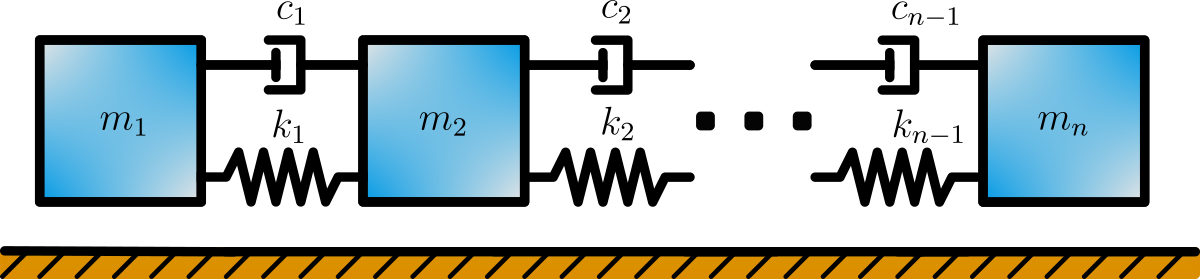
Note
If
stiffnessand/ordampingarguments are passed as array-like objects, the shape of arrays for this boundary condition must be(n_dof-1,).
"left"- the first mass is connected to a rigid surface on the left with a spring and a damper: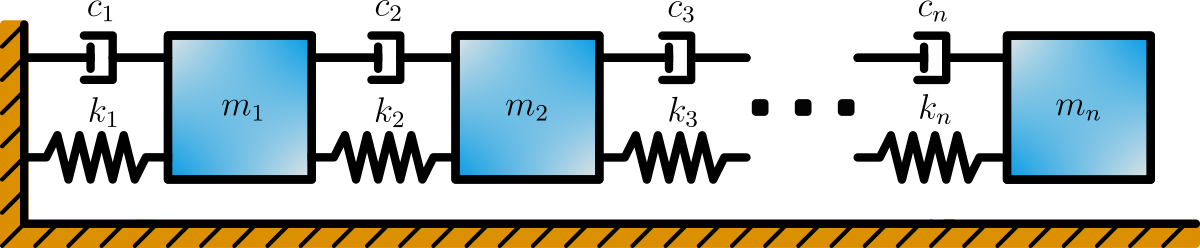
Note
If
stiffnessand/ordampingarguments are passed as array-like objects, the shape of arrays for this boundary condition must be(n_dof,).
"right"- the last mass is connected to a rigid surface on the right with a spring and a damper: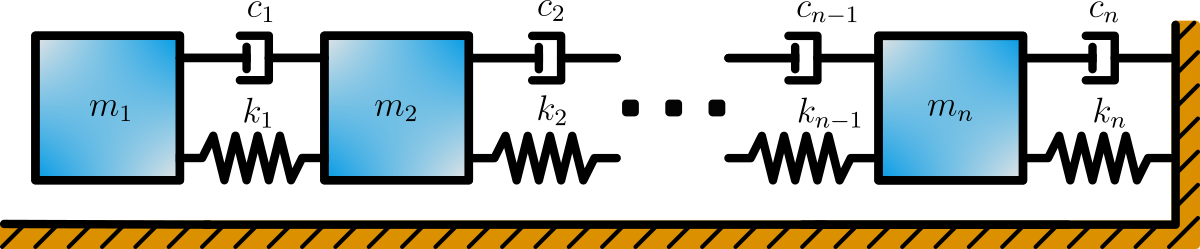
Note
If
stiffnessand/ordampingarguments are passed as array-like objects, the shape of arrays for this boundary condition must be(n_dof,).
Getting system properties
Mass, stiffness and damping matrix
As a result of the following methods we get the array (matrix) of dimensions (n_dof, n_dof):
Mass matrix (M):
M = a.get_mass_matrix()Stiffness matrix (K):
K = a.get_stiffness_matrix()Damping matrix (C):
C = a.get_damping_matrix()
Eigen frequencies, eigen values, eigen vectors and viscous damping ratios
The following methods are obtained via state-space model of the system:
Array of eigen frequencies (in Hz):
eig_freq = a.get_eig_freq()Tuple of eigen values and their conjugate pairs:
eig_val = a.get_eig_val()Tuple of eigen vectors and their conjugate pairs:
eig_vec = a.get_eig_vec()Viscous damping ratios of the system:
d_ratios = a.get_damping_ratios()
Frequency response functions
To get the FRF matrix of the system we call the following method:
frf_matrix = a.get_FRF_matrix(freq, frf_method="f", **kwargs)
freq argument
Frequency array (in Hz) at which the FRF values are calculated.
frf_method argument
Method used to calculate the FRF matrix:
"f"(default): frequency domain, via impedance inverse.
"s": state space domain, via state-space model parameters.
Note
If the selected method for FRF calculation is the state space domain method (frf_method="s"), we can provide an optional keyword argument
n_modes to specify the number of modes used in FRF calculation via mode superposition method. If not specified, all the modes are used.
Impulse response functions
To get the impulse response function (IRF) matrix of the system we call the following method:
irf_matrix = a.get_IRF_matrix(freq, frf_method="f", return_t_axis=False, **kwargs)
freq argument
Frequency array (in Hz) at which the FRF values are calculated.
frf_method argument
Method used to calculate the FRF matrix, from which the impulse response function matrix is caluclated via inverse FFT:
"f"(default): frequency domain, via impedance inverse.
"s": state space domain, via state-space model parameters.
Note
If the selected method for FRF calculation is the state space domain method (frf_method="s"), we can provide an optional keyword argument
n_modes to specify the number of modes used in FRF calculation via mode superposition method. If not specified, all the modes are used.
return_t_axis argument
If True, returns the time axis of impulse response functions.
Note
If True the method returns a tuple with two elements: (irf_matrix, time_series).
Obtaining systems response
To obtain the systems response to known excitation we can use the get_response() method:
response = a.get_response(
  exc_dof,
  exc,
  sampling_rate,
  resp_dof,
  domain="f",
  frf_method="f",
  return_matrix=False,
  return_t_axis=False,
  return_f_axis=False,
  **kwargs
)
exc_dof argument
The degrees of freedom array where excitation is applied.
exc argument
The excitation time series array of dimensions (len(exc_dof), time_points).
sampling_rate argument
Sampling rate of excitation signals.
resp_dof argument
Degrees of freedom where we want the response to be calculated. If None (by default) the responses at all degrees of
freedom are calculated.
domain argument
Method used to calculate the response (frequency or time domain):
"f"(default): multiplication in the frequency domain.
"t": convolution in time domain.
Note
If we choose the time domain response calculation (domain="t"), we can also use the two additional keyword arguments mode and
method, which control the convolution calculation. See code documentation for further info.
frf_method argument
Method used to calculate the FRF matrix:
"f"(default): frequency domain, via impedance inverse.
"s": state space domain, via state-space model parameters.
Note
If the selected method for FRF calculation is the state space domain method (frf_method="s"), we can provide an optional keyword argument
n_modes to specify the number of modes used in FRF calculation via mode superposition method. If not specified, all the modes are used.
return_matrix argument
If True, returns the matrix that was used to calculate the reponse - FRF matrix (domain="f") or
impulse response function matrix (domain="t").
return_t_axis argument
If True, returns the time axis of response and excitation signals.
return_f_axis argument
If True, returns the frequnecy axis of the FRF matrix.
Note
If any of the return_matrix, return_t_axis, return_f_axis is True, the result of the method is a tuple with all
the requested returned items.